

Our top three turntables


Availability checked — 16 September 2026: exact Australian listings were live for all three models. Apollo Hi-Fi listed the Pro-Ject at $1,169, Vinyl Revival listed the AT-LP70XBT at $599 and the AT-LP120XUSB at $679. Prices, finishes and local stock can change without warning.
Pro-Ject Debut EVO 2
It puts the money into the parts that matter for a lasting hi-fi system: a damped aluminium platter, carbon tonearm, replaceable cartridge, effective isolation and conventional detachable connections.
The best turntable is not necessarily the one with the most features. It is the model that suits your willingness to handle records manually, connects properly to your existing equipment and leaves enough of the budget for speakers, amplification and record care.
Our 2026 Australian shortlist follows three genuinely different paths. The Pro-Ject Debut EVO 2 is the stronger choice for a serious wired hi-fi system. The Audio-Technica AT-LP70XBT is easier to use and includes automatic operation, Bluetooth and a built-in phono stage. The AT-LP120XUSB adds direct drive, manual adjustment, 78 RPM and USB recording.
The short answer
Choose the Pro-Ject Debut EVO 2 if sound quality, cartridge flexibility and long-term system upgrades matter most. It is manual, needs a phono stage and costs more, but provides the best foundation for a capable amplifier and speakers.
Choose the Audio-Technica AT-LP70XBT if convenience matters most. You can press start, let it return the arm automatically and connect it to powered speakers, a line input or Bluetooth equipment.
Choose the Audio-Technica AT-LP120XUSB if you want hands-on control or plan to digitise records. Its direct-drive motor, removable headshell, adjustable controls and USB output suit enthusiasts who want more flexibility without adding an external phono stage immediately.
Before buying
A turntable does not always connect directly to ordinary speakers. Confirm whether your amplifier has a phono input, whether the turntable has a built-in phono stage and whether your speakers are powered or passive.
Our shortlist at a glance
- Best overall hi-fi turntable: Pro-Ject Debut EVO 2 — manual belt drive, external phono stage required.
- Best easy-to-use turntable: Audio-Technica AT-LP70XBT — fully automatic belt drive with Bluetooth and switchable phono stage.
- Best for USB and manual control: Audio-Technica AT-LP120XUSB — fully manual direct drive with 33⅓, 45 and 78 RPM.
How we chose the turntables
We considered current Australian availability, official specifications, system compatibility, cartridge and stylus options, serviceability, upgrade potential and the complete cost of getting music through speakers. This is an editorial shortlist, not a claim that every competing turntable was laboratory-tested under identical conditions.
No manufacturer or retailer paid for inclusion. We excluded cheap suitcase players and novelty all-in-one systems because their lightweight mechanisms and tiny built-in speakers generally make them poor long-term purchases.
1. Pro-Ject Debut EVO 2
The strongest long-term foundation for a dedicated stereo system.
The Debut EVO 2 concentrates its budget on the platter, bearing, tonearm, cartridge and isolation instead of Bluetooth, automatic mechanisms or digital outputs. Electronic speed switching means you do not need to move the belt when changing between 33⅓ and 45 RPM.
Its 1.7 kg die-cast aluminium platter uses a thermoplastic-elastomer damping ring. The 8.6-inch one-piece carbon tonearm is supplied with the replaceable Pick it MM EVO moving-magnet cartridge, while gold-plated RCA sockets let you replace the phono cable later.
It remains a manual turntable: you place the stylus on the record and lift it at the end. It has no built-in phono preamplifier, Bluetooth or USB output, so factor the rest of the system into the real purchase price.
What we like
- Heavy damped aluminium platter.
- Light, rigid carbon tonearm.
- Replaceable cartridge and detachable RCA cable.
- Electronic speed selection.
- Useful long-term upgrade path.
What to consider
- No built-in phono stage.
- No automatic return, Bluetooth or USB.
- Needs careful setup and a stable surface.
- Total system cost can rise quickly.
Best for: listeners with a capable amplifier and speakers who want a turntable that will not immediately become the weak point in a serious hi-fi system.
2. Audio-Technica AT-LP70XBT
The simplest route from a record to powered speakers or Bluetooth audio.
The AT-LP70XBT can position and return the tonearm automatically. Its switchable phono preamplifier sends either a phono-level or line-level signal, while Bluetooth supports SBC, aptX and aptX Adaptive when the receiving device supports the same codec.
The fitted AT-VM95C cartridge body is integrated into the tonearm and cannot be replaced, but compatible VM95-series styli provide a practical upgrade path without cartridge alignment.
Bluetooth is convenient, not the most direct signal path. A wired connection avoids wireless conversion and is the better starting point when sound quality matters more than cable-free placement.
What we like
- Automatic start, stop and arm return.
- Switchable phono/line output.
- Wired and Bluetooth playback.
- VM95 stylus upgrade choices.
- Very little setup knowledge required.
What to consider
- Cartridge body is fixed.
- No USB recording output.
- Bluetooth adds digital conversion.
- Lighter and less adjustable than the other picks.
Best for: beginners, shared households and listeners who value automatic operation and flexible connections more than extensive adjustment.
3. Audio-Technica AT-LP120XUSB
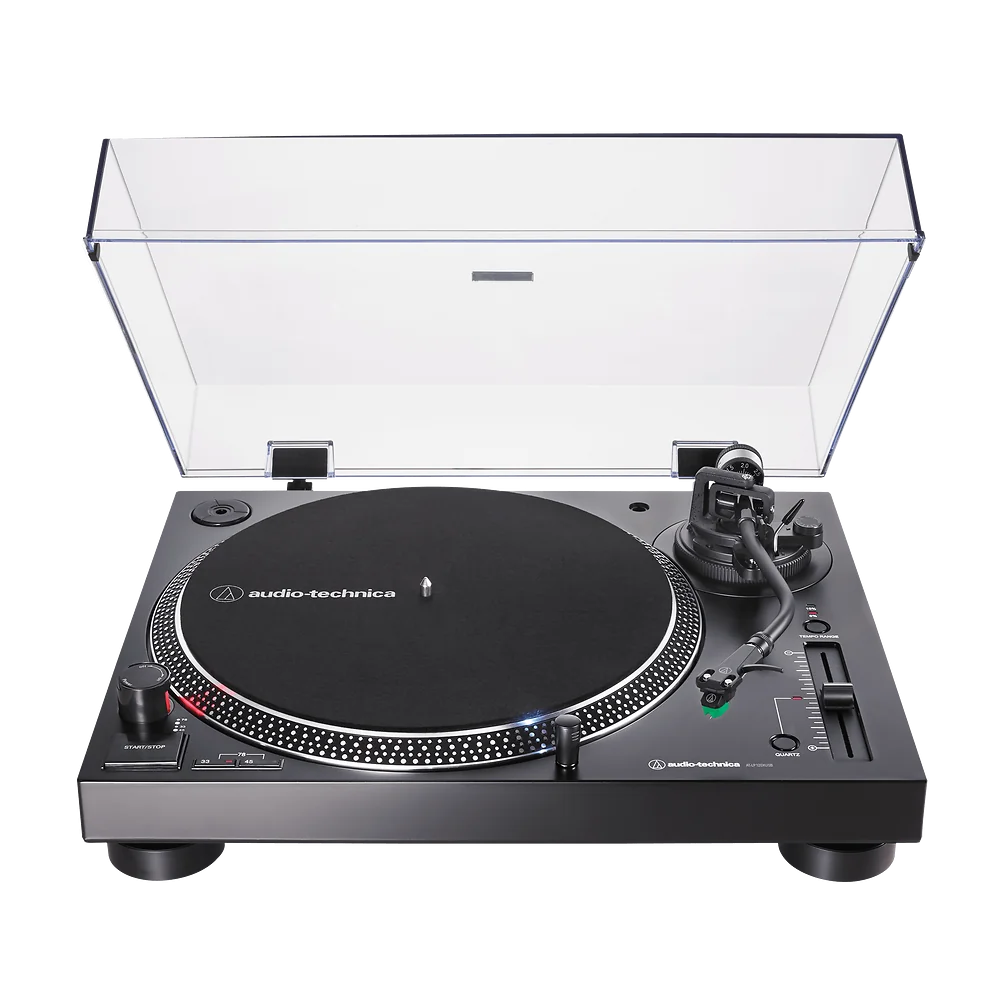
A versatile manual deck for archiving records and learning turntable setup.
The AT-LP120XUSB uses a DC servo direct-drive motor and offers adjustable tracking force, dynamic anti-skate, pitch control and quartz speed lock. Its removable universal headshell carries an AT-VM95E moving-magnet cartridge with an elliptical stylus.
A switchable phono preamp allows phono- or line-level analogue output. The USB connection can send 16-bit audio at 44.1 or 48 kHz to a computer for recording with suitable software.
It is fully manual rather than automatic, and its DJ-inspired controls are unnecessary for buyers who simply want one-button playback. It makes sense when those controls, 78 RPM support or USB archiving will actually be used.
What we like
- Stable direct-drive motor.
- Three speeds including 78 RPM.
- USB and detachable analogue outputs.
- Replaceable cartridge and removable headshell.
- Useful adjustment and pitch controls.
What to consider
- No automatic start or return.
- Large and heavy at about 8 kg.
- More controls than a simple listener needs.
- 78 RPM records normally need a suitable stylus.
Best for: listeners who want direct drive, cartridge flexibility, 78 RPM playback or a straightforward way to digitise records.
Why these three made the shortlist
A longer list can hide the decision that matters most. Buyers usually need to choose among an easy automatic player, a focused manual hi-fi deck and a more adjustable direct-drive model with digital archiving.
These three represent those paths clearly. The Pro-Ject prioritises the analogue mechanism, the LP70XBT removes setup hurdles, and the LP120XUSB adds practical tools for hands-on users.
What equipment do you need?
- Built-in phono stage plus powered speakers: usually only the correct audio cable is required.
- Built-in phono stage plus passive speakers: an amplifier or receiver is still required to power the speakers.
- No phono stage plus an amplifier with a PHONO input: connect to the correct moving-magnet input and attach the ground wire where required.
- No phono stage plus line inputs only: add an external phono preamplifier.
- Bluetooth turntable plus wireless speaker or headphones: pair with a compatible Bluetooth receiver; codec support must match to use aptX features.
A phono stage is not the amplifier that powers passive speakers. It boosts the cartridge's tiny signal and applies the required equalisation. Powered speakers contain their own amplifier; passive speakers do not.
Manual versus automatic turntables
Manual operation
You move the tonearm over the record, lower the stylus and lift it when the side finishes. The simpler mechanism can allow more of the manufacturing budget to go into the platter, bearing, arm and cartridge. Manual operation is not difficult, but it requires attention and careful handling.
Fully automatic operation
An automatic model can position the tonearm and return it at the end. This is useful for shared systems, people with limited dexterity and anyone likely to forget that a side has finished. The extra mechanism can limit tonearm or cartridge adjustment, which is a different priority rather than an automatic flaw.
Belt drive versus direct drive
The Pro-Ject and LP70XBT are belt driven. A belt separates the platter from the motor and is common in domestic hi-fi designs, but it is a wear item that will eventually require replacement.
The LP120XUSB places its direct-drive motor beneath the platter. It starts quickly, provides pitch control and maintains stable speed. Drive type alone does not decide sound quality; the motor, platter, bearing, tonearm, cartridge and isolation all matter.
Do you need Bluetooth or USB?
Bluetooth is useful when a cable across the room is impractical or you already own compatible wireless headphones or speakers. It converts the analogue signal for wireless transmission, so a wired connection remains the cleaner path when maximum fidelity is the goal.
USB is different: it lets the LP120XUSB send audio to a computer for archiving. It will not repair surface noise, groove wear or a poor pressing. Cleaning the record and setting the turntable correctly still matter before recording.
Practical rule
Treat Bluetooth and USB as useful connection features, not evidence that one turntable sounds better than another.
Budget for the whole system
The advertised turntable price may be only part of the cost. Depending on your equipment, allow for a phono preamplifier, integrated amplifier or receiver, powered or passive speakers, a rigid stand, record and stylus brushes, cleaning supplies, replacement sleeves and eventual stylus and belt replacement.
Do not spend nearly the entire budget on the turntable and connect it to poor speakers. Speakers, placement and room acoustics usually produce a larger audible change than a modest cartridge upgrade.
Cartridge and stylus upgrades
The stylus is the replaceable assembly containing the diamond that follows the groove. The cartridge converts its movement into an electrical signal.
The LP70XBT fixes the AT-VM95C cartridge body into its tonearm but accepts compatible VM95 replacement styli. The LP120XUSB uses a removable headshell and replaceable cartridge. The Pro-Ject also permits a complete cartridge change, providing more freedom but requiring correct alignment, tracking force and phono-stage compatibility.
An expensive cartridge installed badly can perform worse and cause more wear than a correctly set-up standard cartridge.
How to set up a turntable properly
- Use a rigid, level surface. It should not rock or flex when someone walks past.
- Keep it away from speakers. Acoustic vibration can feed back through the stylus.
- Install the platter and belt correctly. Follow the supplied instructions.
- Set tracking force accurately. On adjustable models, follow the cartridge manufacturer's range.
- Set anti-skate where provided. Begin with the manufacturer's recommendation.
- Select PHONO or LINE correctly. Do not feed a line-level output into a phono input.
- Connect the ground wire where required. A poor ground can cause hum.
- Keep the stylus clean. Brush from back to front with a tool designed for styli.
How to protect records
- Handle records by their edges and labelled centre area.
- Store them vertically, away from sunlight, heaters and hot cars.
- Replace damaged paper sleeves with suitable anti-static sleeves.
- Remove loose dust before play and wet-clean dirty second-hand records properly.
- Replace a worn or damaged stylus promptly.
- Use the cueing lever instead of dropping the stylus by hand.
What to check before buying
- Phono stage: confirm whether the output switches between PHONO and LINE.
- Amplifier: look for a labelled phono input rather than assuming every RCA socket will work.
- Speaker type: passive speakers require amplification; powered speakers do not.
- Upgrade path: decide whether stylus replacement is enough or you want a removable cartridge.
- Speeds: 78 RPM needs the correct speed and normally a suitable stylus.
- Dimensions: measure the cabinet with cables attached and the dust cover open.
- Parts: check local availability and price of the stylus and belt.
- Australian stock: buy from an authorised local retailer where practical.
Turntables we would avoid
Be cautious with very cheap suitcase-style players and compact all-in-one systems using tiny built-in speakers. Lightweight platters, limited tonearms and basic cartridges can produce unstable speed, mistracking and disappointing sound.
Do not buy a vintage turntable solely because it was once expensive. A restored model can be excellent, but belts, lubrication, capacitors, tonearm bearings, cartridge suspension and automatic mechanisms may need attention. Budget for professional inspection if you cannot assess it yourself.
Frequently asked questions
Can I connect a turntable directly to speakers?
Only with the right combination. Powered speakers need a line-level signal, so the turntable must have a built-in phono stage or use an external one. Passive speakers also require an amplifier.
Can I connect a turntable to a soundbar?
Sometimes, if the soundbar has a compatible analogue, Bluetooth or other supported input. A phono-level signal cannot feed a normal line input without a phono stage.
Will Bluetooth ruin the sound?
No, but it introduces analogue-to-digital conversion and may use lossy compression. Use a wired connection when maximum fidelity is the goal.
How often should the stylus be replaced?
There is no universal interval. Stylus profile, tracking force, record cleanliness and use all matter. Follow the manufacturer's guidance and investigate increasing distortion, mistracking or visible damage.
Does an expensive turntable make old records sound new?
No. Better equipment can retrieve more information, but it also reveals dirt, damage and poor mastering. Clean records carefully and replace badly worn copies where practical.
Our verdict
The Pro-Ject Debut EVO 2 is our choice for listeners building a lasting hi-fi system. Its replaceable cartridge, damped aluminium platter, carbon arm and detachable connections provide the strongest foundation, provided you supply a suitable phono stage.
The Audio-Technica AT-LP70XBT is the better starting point for convenience. Its automatic mechanism, Bluetooth and built-in phono stage remove several setup hurdles.
The AT-LP120XUSB is the practical specialist. Buy it for direct drive, manual adjustment, 78 RPM or computer recording—not merely because it has more controls.
Buy for the system you will actually use, not for a romantic promise that vinyl automatically sounds better.
Sources and further reading
- Pro-Ject Audio Systems — Debut EVO 2 specifications
- Apollo Hi-Fi — Pro-Ject Debut EVO 2 Australian listing
- Pro-Ject Audio Australia — warranty information
- Audio-Technica Australia — AT-LP70XBT specifications
- Audio-Technica Australia — AT-LP120XUSB specifications
- Audio-Technica — Australian warranty information
- ACCC — consumer rights and guarantees
Availability and prices checked: 16 September 2026. Products, finishes, retailer stock and prices can change. Confirm the exact model, included cartridge, warranty and checkout price before ordering.
Need a second opinion?
Ask Adrian before making the decision.
Tell us what you are choosing between, what matters most to you and what you have already checked.